

OUR
SERVICES
FUEL QUALITY &
TANK AUDITS
FUEL SAMPLING
& ANALYSIS
FUEL POLISHING
TANK CLEANING
FUEL TREATMENT
& STABILIZATION
PREVENTATIVE FUEL MAINTENANCE
Service Report
See the process, results, and documentation provided with every service.
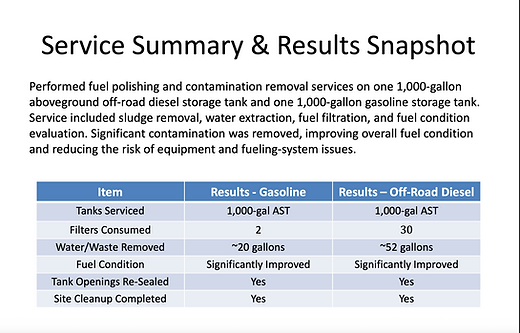
*A full service report example may be provided upon request.

WHO
WE ARE
Coastal Fuel Services provides professional fuel polishing and maintenance services designed to keep stored fuel clean, stable, and ready for use. Over time, fuel naturally degrades — and when contaminants build up, they can cause costly equipment failures and unexpected downtime. Our job is to prevent that before it becomes a problem. Some areas we work with include:
✓ Government & Municipal
✓ Commercial Fleets
✓ Standby Generators
✓ Industrial Facilities
✓ Marine
✓ Construction & Aggregates

OUR
TEAM
Brandon Cross is the owner and operator of Coastal Fuel Services. Having worked across the East Coast, he knows firsthand the challenges businesses face in keeping fuel systems reliable and equipment running smoothly.
Whether he’s on-site troubleshooting, overseeing operations, or guiding clients through preventative maintenance, he treats every job as if it were his own equipment at stake. For Brandon, it’s about trust, reliability, and building relationships. Clients appreciate that he brings not just technical knowledge and abilities, but a personal touch, a problem-solving mindset, and a commitment to making their operations safer, smoother, and more efficient. He is passionate about providing excellence in customer service and solutions that actually work.
OUR
WORK
We bring our mobile fuel service directly to your location, with a fully equipped unit designed to handle fuel issues on-site. Whether you’re managing generators, vessels, fleets, or storage tanks, our goal is to make the process simple and efficient without disrupting your operation.
We start by sampling and analyzing your fuel to check for water, contamination, and microbial growth. From there, we walk you through what we find, answer questions, and help you decide on the best next steps based on how your fuel is being used and stored.
When fuel polishing is needed, we run the fuel through a closed-loop filtration process that removes water, sludge, sediment, and biological contaminants, returning clean, reliable fuel back into the tank. This helps extend fuel life, improve performance, reduce downtime, and lower the total cost of ownership.


Fuel polishing is a closed-loop filtration process designed to clean and restore stored fuel without removing it from the tank. It is a preventative maintenance solution that improves fuel quality, reliability, and equipment performance.
Step 1: Fuel Extraction
Fuel is drawn from the storage tank using a suction line. This allows the system to access both the main fuel supply and the lower areas of the tank where water, sludge, and sediment naturally settle over time.
Step 2: Filtration (10, 5, and 1 Micron)
Fuel first passes through a 10 micron filter that removes larger debris such as rust particles, tank scale, and heavier sediment. This protects downstream components and begins the cleaning process.
We then transition to a 5 micron filter, which removes finer particulate matter that can contribute to injector wear, poor combustion, and reduced engine efficiency.
Finally, the fuel is polished through a 1 micron filter, capturing extremely fine contaminants including microscopic debris, carbon fines, and degraded fuel particles that can negatively impact fuel system performance.
Step 3: Water Separation
In addition to filtration, the system removes both free and emulsified water from the fuel. This is critical for preventing microbial growth, corrosion, and fuel instability.
Step 4: Return to Tank
Once cleaned, the fuel is returned back into the storage tank. The continuous circulation process ensures the entire fuel volume is gradually polished, not just a portion of it.

HOW
IT
WORKS
FAQ
Why does clean fuel matter?
Even small amounts of contamination can lead to:
-
Plugged filters
-
Reduced engine efficiency
-
Increased wear on fuel systems
-
Unexpected generator or equipment failure
What is fuel polishing?
Fuel polishing is the process of cleaning and conditioning stored fuel to remove water, sediment, and contaminants. Over time, fuel can degrade, causing corrosion, clogging filters, and reducing equipment performance.
Polishing ensures your fuel stays clean, reliable, and ready to use, protecting engines and reducing total cost of ownership.
Why are multiple filters used?
Different contaminants require different filtration stages. Using multiple filters allows us to remove larger debris first, then progressively remove smaller particles and water, resulting in cleaner, more reliable fuel.
Our fuel polishing system filters fuel down to 10, 5, and 1, microns, helping protect sensitive fuel injectors, pumps, and engine components from damaging contaminants. To put that into perspective, a single human hair is approximately 70 microns in diameter, meaning our filtration system captures particles more than 30 times smaller than the width of a human hair.
This level of filtration helps improve fuel quality, reduce equipment wear, and support the long-term reliability of your engines and fuel systems.
Can polishing extend the life of my equipment?
Absolutely! Contaminated fuel is a major cause of equipment failure, filter clogging, and costly repairs. Polishing protects engines, generators, and storage tanks, extending their life and maintaining efficiency.
Will fuel polishing cause downtime?
In most cases, fuel polishing causes little to no downtime. The process is performed with the fuel remaining in the tank and can often be done while equipment is offline, between run cycles, or during low-use periods. When continuous operation is required, we plan the work around your schedule to minimize disruption as much as possible.
I don't think I have fuel problems. Why would I need polishing or testing?
Fuel problems aren't always obvious. Your equipment may still run, but contaminated fuel can cause:
-
Frequent fuel filter changes
-
Injector or fuel pump failures
-
Increased DPF regenerations
-
Hard starts or rough running
-
Loss of power or fuel economy
-
Recurring fault codes
-
Generator alarms or shutdowns
-
Water, sludge, or sediment in the fuel system
Many costly maintenance issues can be traced back to poor fuel quality. A fuel sample can identify contamination before it leads to expensive repairs or downtime.